Empathy Isn’t “Soft.” It’s Stabilizing.

Healthcare educators sometimes hesitate when they hear the words empathy
training.
Will it feel too emotional?
Too abstract?
Too “extra”?
What I see instead is something very different.
Learners don’t become overwhelmed.
They become grounded.
Programs that intentionally integrate empathy consistently report stronger
engagement and fewer communication breakdowns during training. Why? Because
empathy helps people stay steady when things are hard—for patients and providers.
And steadiness is what my work is really about.
The First Five Rules
“Breathe, breathe, breathe, breathe and DON’T PANIC!”
Those are the first five rules of SCUBA diving.
They’re also the first five rules of life.
And the first five rules of healthcare.
I learned that the hard way.
The First Time I Broke the Rules
Thirty feet underwater in a cold quarry, my instructor asked me to flood my mask. I
tilted my head forward. Icy water rushed in. A little went up my nose.

I panicked.
I ripped off my mask, spit out my regulator, and bolted for the surface.
My instructor grabbed my ankles to slow my ascent so my lungs wouldn’t burst from the pressure change. I knew the rules. I knew surfacing too fast could cause an
embolism.
But panic overrides knowledge.
As he tried to save my life, I kicked to get away. I was desperate to breathe.
The Second Time I Broke the Rules
After surgery, I woke up with a tracheostomy tube in my neck. Every breath rasped.
Condensation collected inside the tube. I sounded like Darth Vader.
I was terrified.
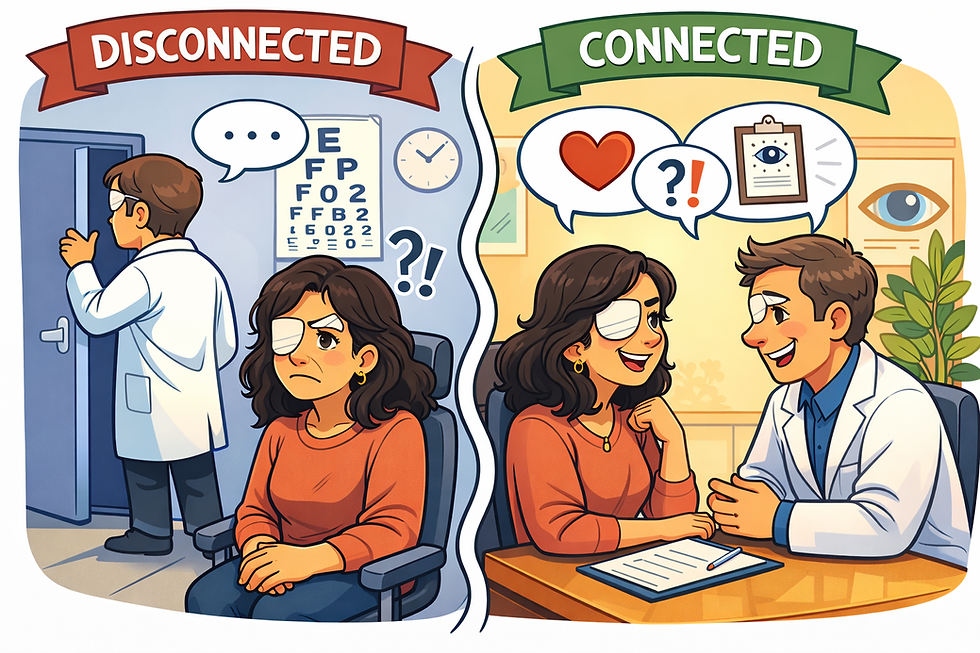
Some nurses scolded instead of calming me.
But here’s what I understand now:
The first job of a healthcare professional is to help the patient breathe without
panicking.
Only then can you build connection.
Only then can you gain cooperation.
Only then can learning or healing begin.
And Then There Was Susan
In rehab, I met a nurse named Susan — “the nicest person on the planet.” I trusted her.
When my feeding tube was accidentally pulled out and had to be reinserted — while I
was awake — I didn’t fight.
If you’ve never had a tube threaded through your nose, down your throat, and into
your stomach, it’s hard to describe how awful it feels.
My usual battle cry during procedures is: “Wait!”
But with Susan, I stayed steady.
Because I trusted her.
She got it in on the first try.
Empathy didn’t make her soft.
It made her stabilizing.
Empathy Regulates the Room
Empathy regulates the room.
It lowers panic.
It steadies breathing.
It allows oxygen — literally and figuratively — to return.
When learners understand that empathy is a clinical tool for steadiness — not
sentimentality — everything changes.
Engagement improves.
Communication strengthens.
Outcomes follow.
Breathe.
Don’t panic.
Then connect.
That’s the work.


Comments